Publications
Jump to: Research Publications · Reports · Talks and Presentations · News and Press Releases · Blog
Research Publications
A Framework for Multidisciplinary Science Observations From Commercial Ships
By Alison M. Macdonald, Luna Hiron, Leah McRaven, Laura Stolp, Kerry Strom, Rebecca Hudak, Shawn R. Smith, Julia Hummon, and Magdalena Andres
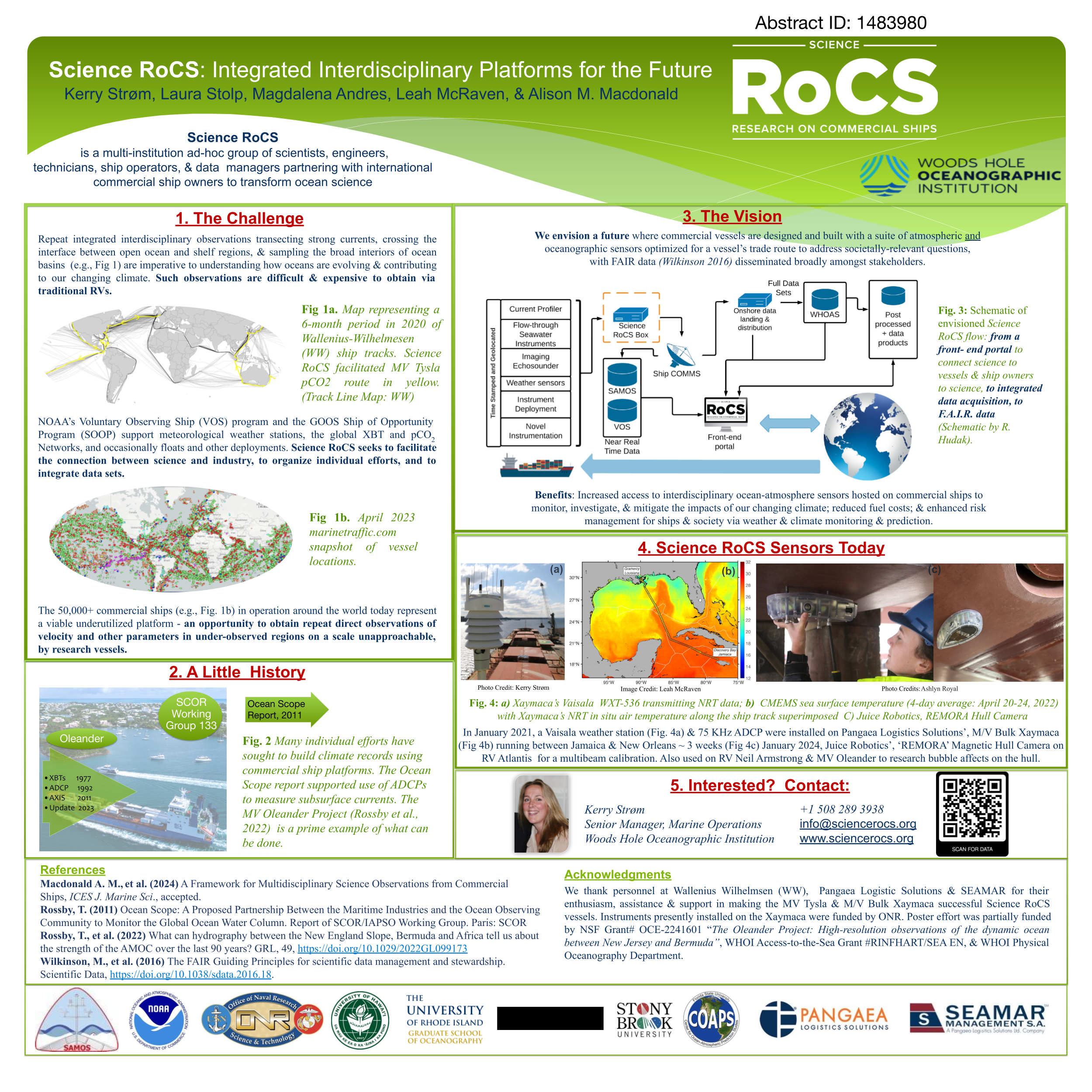
Science RoCS aims to foster cooperation between the shipping industry and scientific community at a level that will be transformative for societally relevant ocean science, promote cross-disciplinary ocean science through simultaneous observation of the air/sea interface and water column, and spur a technological revolution in observational oceanography by developing new turnkey, maritime-industry-appropriate scientific equipment whose data streams can be used to stimulate innovations in oceanic (physical, chemical, and biological) understanding and forecasting.
Professional Talks and Presentations
Download ARM/ASR PI Meeting 2025 - Krishnamurthy_et_al_2025
Boundary Layer Exploration of Aerosols and Clouds ON Ships (BEACONS) Pilot Study
By Raghavendra Krishnamurthy, Matthew Christensen, Chitra Sivaraman, Adam Ryan, Gourihar Kulkarni, Johannes Muelmenstaedt, Jerome D. Fast, Larry Berg, Timothy S. Bates, Harindra Fernando, Lynn M. Russell, Alison Macdonald, Rebecca Hudak, Kerry Strom, Derek Coffman, and Patricia Quinn
The Boundary layer Exploration of Aerosols and Clouds ON Ships (BEACONS) project plans to enhance our understanding of marine atmosphere and aerosol-cloud interactions by deploying an autonomous ship-borne system for routine observations of critical aerosol and cloud properties.
Reports
- Observing Marine Aerosols and Clouds from Ships: 2024 Workshop Report (June 2024). U.S. Department of Energy, Office of Biological and Environmental Research.
- OceanScope: A Proposed Partnership Between the Maritime Industries and the Ocean Observing Community to Monitor the Global Ocean Water Column. Rossby, T. (2012). Report of SCOR/IAPSO Working Group. Paris: SCOR.
- Vessel Recruiting Best Practices (Version 2.0, 2025). Ocean Best Practices Repository.
News and Press Releases
- From Cargo Route to Atmospheric Observatory (October 19, 2026). Pacific Northwest National Laboratory article on the BEACONS project.
- Scientists are becoming ocean hitchhikers to fill data gaps (October 3, 2024). Daniel Cressey, Dialogue Earth.
- BEACONS Sets Sights for Data from Commercial Ships (September 26, 2024). Pacific Northwest National Laboratory news story on the BEACONS project.
- Scientists Team with Commercial Shipping Industry to Collect Ocean Observations in the Caribbean Sea (August 25, 2023). Jessica Mkitarian, NOAA Global Ocean Monitoring and Observing.
- Commercial ship tracks Gulf of Mexico’s hurricane heat potential (June 27, 2022). Woods Hole Oceanographic Institution, Oceanus magazine.
- WHOI & Pangaea Logistics Solutions to advance ocean science data acquisition through Science RoCS program (April 11, 2022). Woods Hole Oceanographic Institution press release.
- Science RoCS Initiative responds to need for increased ocean monitoring (June 10, 2021). Woods Hole Oceanographic Institution, Oceanus magazine.
Blog
Commentary on ocean observation from commercial ships by Tom Rossby. Read the full blog.
Technology
- A thought on ADCP processing (Sep 10, 2024)
Suggests a sliding-window approach to shipboard ADCP processing that makes use of all good data and also yields horizontal velocity gradients. - LIDAR (Sep 9, 2024)
Asks why oceanographers haven’t put lidar on research and merchant vessels to map the vertical distribution of plankton and particles along their routes. - Addressing the bubble problem (Jun 27, 2024)
Recounts how bubbles from the Norröna’s bow thrusters blinded its ADCP, and the fairing and hull-design ideas used to get around them. - I don’t get it. (Jun 14, 2024)
Argues that satellites can only see the ocean surface, and that regularly repeated ship sections are how we can measure currents and their variability below it. - Needed, a modern XCTD. (Apr 22, 2024)
Makes the case for a low-cost, modern expendable CTD that merchant ships could deploy, building on the 50-year-old XBT. - Partnering with the Merchant Marine. (Apr 4, 2024)
Argues that merchant ships could provide sustained ground truth for satellites and extend observations below the surface, yet the oceanographic community rarely works with them. - Scanning deep ocean currents. (Jan 15, 2024)
Looks at how ships underway could measure currents at depth, starting from ADCPs that already reach 600–1,200 m. - On the challenges of sustained ocean observation. (Oct 12, 2023)
Traces oceanography’s shift from hydrography to measuring currents directly, and asks why ADCPs on ships in regular traffic, as on the Oleander since 1992, aren’t used more widely. - Ships as sea level satellites (Oct 6, 2023)
Compares merchant vessels to satellites orbiting at sea level, from Matthew Fontaine Maury’s 19th-century ship reports to the instruments ships carry today. - The extraordinary potential of merchant marine vessels for ocean science. (Oct 4, 2023)
Argues that the shipping industry’s constant presence on the high seas could do far more for ocean observation than current programs ask of it, especially by scanning currents with ADCPs.
Science
- The Warming Hole. (Aug 9, 2024)
Explains the region south of Greenland that has warmed less than its surroundings and questions whether it really signals a slowing AMOC. - Acoustic backscatter in cold core rings (Jul 5, 2024)
Uses Oleander ADCP data to follow how cold core rings spin up after forming and how the acoustic backscatter in their centers changes from a maximum to a striking void. - The Norröna and the Faroe-Shetland Channel (Jun 21, 2024)
Describes how Norröna ADCP data revealed an unexpected southward flow on the western side of the Faroe-Shetland Channel. - The Norröna Project. (May 30, 2024)
Tells the story of instrumenting the Norröna, a ferry whose route crosses all the warm water entering the Nordic Seas, and the problems that began as soon as she left port. - Flow north in the Iceland Basin. (May 23, 2024)
Shows how repeat ADCP sections from the Nuka Arctica and Norröna mapped upper-ocean circulation in the Iceland Basin, revealing that most Faroe-Shetland Channel water comes from the Iceland Basin rather than Rockall Trough. - Two lovely sections of acoustic backscatter. (May 7, 2024)
Shows acoustic backscatter sections from the Nuka Arctica and makes the case that the echo strength recorded by ADCPs is an underused source of information. - Discovery of the two parallel streams of the Irminger Current. (May 2, 2024)
Describes how ADCP data from the container ship Nuka Arctica, sailing between Greenland and Denmark, revealed that the Irminger Current flows as two separate, parallel streams. - Exploring the fourth dimension of the ocean. (Apr 10, 2024)
Argues that deep ocean currents remain a largely unexplored part of the ocean, and that ADCPs on merchant ships can monitor them in both space and time. - The Ekman layer as seen by the Oleander (Mar 28, 2024)
Explains how nearly a decade of Oleander ADCP data was used to detect the wind-driven Ekman spiral. - Wanted, a lens detector. (Feb 20, 2024)
Describes a method developed with Oleander ADCP data to automatically detect rings and other coherent eddies along the ship’s route. - Fresh water and the AMOC (Nov 13, 2023)
Discusses where Arctic fresh water may affect the overturning circulation and proposes monitoring subpolar gyre fluxes with ADCPs on ships already crossing the region. - How to measure the AMOC (Oct 29, 2023)
Argues that western boundary currents such as the Gulf Stream offer convenient places to keep track of the AMOC, since they carry all of the poleward-flowing water. - The Oleander Project (Jul 27, 2023)
Introduces the Oleander Project, which since 1992 has used a ship-mounted ADCP on weekly Bermuda–New Jersey runs to monitor the strength of the Gulf Stream.